<?xml version="1.0" encoding="utf-8"?><feed xmlns="http://www.w3.org/2005/Atom" ><generator uri="https://jekyllrb.com/" version="3.10.0">Jekyll</generator><link href="https://jingyi.me//sabbatical-blog/feed.xml" rel="self" type="application/atom+xml" /><link href="https://jingyi.me//" rel="alternate" type="text/html" /><updated>2026-08-14T04:55:26+00:00</updated><id>https://jingyi.me//sabbatical-blog/feed.xml</id><title type="html">Jingyi Li</title><subtitle>Jingyi Li is an HCI researcher at Pomona College.
</subtitle><entry><title type="html">what’s jingyi doing on sabbatical • vol 2</title><link href="https://jingyi.me//sabbatical-blog/two.html" rel="alternate" type="text/html" title="what’s jingyi doing on sabbatical • vol 2" /><published>2026-08-13T00:00:00+00:00</published><updated>2026-08-13T00:00:00+00:00</updated><id>https://jingyi.me//sabbatical-blog/two</id><content type="html" xml:base="https://jingyi.me//sabbatical-blog/two.html"><![CDATA[<!DOCTYPE html>
<html>
   <head>
      <meta charset="utf-8">
      <meta name="viewport" content="width=device-width,initial-scale=1">
      <title>what's jingyi doing on sabbatical • vol 2</title>
      <link rel="preconnect" href="https://fonts.googleapis.com">
      <link rel="preconnect" href="https://fonts.gstatic.com" crossorigin>
      <link href="https://fonts.googleapis.com/css2?family=Merriweather:wght@400;900&display=swap" rel="stylesheet">

      <style>
        :root {
			--paper: #FAF0E6;
			--aesthetic: #ccc5f2;
			--sky: #b1ddf2;
			--grass: #a2d9ad;
			--text: #3c3633;
			--muted: #8A7D75;
			--border: #95807b;
			--link: #8c4d65;
		}

		* {
			box-sizing: border-box;
		}

		html {
			scroll-behavior: smooth;
		}

		body {
			margin: 0;
			background: var(--paper);
			color: var(--text);
			font: 400 18px/1.95 Merriweather, serif;
		}

		section {
			padding: 2rem 0;
		}

		.content {
			max-width: 760px;
			margin: auto;
			padding: 0 1.5rem;
		}

		h1,
		h2 {
			font-weight: 900;
		}

		a,
		a:visited {
			cursor: pointer;
			color: var(--link);
			text-decoration: none;
			border-bottom: 1px dotted currentColor;
		}

		ol li, ul li {
			padding-left: .75rem;
		}

		ul li {
			margin: 1em 0;
		}

		.image {
			background-image: linear-gradient(to bottom, var(--aesthetic) 65%, var(--sky) 96%);
		}

		.aaa {
			background-image: linear-gradient(to bottom, var(--sky) 65%, var(--grass) 90%);
		}


		.etc {
			background-image: linear-gradient(var(--youch), var(--paper) 5%);
		}

		.date {
			padding-top: 8rem;
		}

		#toc {
			position: fixed;
			top: 1rem;
			right: 1rem;
			width: 300px;
			background: rgba(255, 255, 255, .67); /*haha 67*/
			backdrop-filter: blur(2px);
			border: 1px solid var(--border);
			border-radius: 8px;
			padding: 1rem;
			transition: .25s;
			z-index: 48;
		}

		#toc-close {
		    position: absolute;
		    top: .45rem;
		    right: .55rem;
		    color: var(--muted);

		    border: none;
		    background: none;

		    padding: 0;

		    font: inherit;
		    font-size: 1rem;
		    line-height: 1;
		}

		#toc.hidden {
			opacity: 0;
			transform: translateY(-20px);
			pointer-events: none;
		}

		#toc ol {
			margin: 0 0 0 1rem;
			padding: 0;
		}

		#toc li {
			margin: .4rem 0;
		}

		#toc a {
			color: var(--text);
		}

		.hover-note,
		.hover-img {
			position: relative;
			border-bottom: 1px dotted currentColor;
			cursor: pointer;
		}

		.hover-note-box,
		.hover-img-card {
			position: absolute;
			left: 50%;
			top: calc(100% + 12px);
			transform: translateX(-50%);
			width: min(300px, calc(100vw - 2rem));
			background: #fff;
			border: 1px solid var(--border);
			border-radius: 8px;
			overflow: hidden;
			padding: .9rem;
			opacity: 0;
			visibility: hidden;
			transition: .15s;
			z-index: 47;
			font-size: .9rem;
		}

		.hover-note-box.big {
			width: min(420px, calc(100vw - 2rem));;
		}

		.hover-note:hover .hover-note-box,
		.hover-note.active .hover-note-box,
		.hover-img:hover .hover-img-card {
			opacity: 1;
			visibility: visible;
		}

		.hover-img-card {
			padding: 0;
		}

		.hover-img-card img {
			display: block;
			width: 100%
		}

		.hover-img-caption {
			display: block;
			padding: .8rem .9rem;
			font-size: .75rem;
		}

		@media(max-width:640px) {
			#toc {
				width: 250px;
				font-size: .85rem;
			}

			.hover-note-box,
			.hover-img-card {
		        position: fixed;
		        left: 50%;
		        top: 90%;
		        transform: translate(-50%, -90%);
		        width: max(380px, calc(100vw - 2rem));
		        z-index: 47;
			}

			.date {
				padding-top: 12rem;
			}
		}
      </style>
   </head>
   <body>
      <nav id="toc">    
      	<button id="toc-close" aria-label="close">&times;</button>
      	<b>Table of Contents</b>
        <div id="toc-content"></div>
    </nav>
      
<section class="time">
    <div class="content">
        <p class="date">August 13, 2026</p>

        <h2>On time</h2>

        <p>
           There was a time not too long ago when my friends asked each other how they visualized time. I don’t really think about time too much, so my answer was practical: my mind’s eye saw an abstraction of the Google Calendar UI. I imagine my answer then was disappointing. But now that I’ve experienced an abundance of time, trying to squeeze the sausage of the past towards “art making” in the present, I see time as a ribbon that can be folded and shaped in <span class="hover-note">2D space.<span class="hover-note-box">
                    Because that’s the simplest space for me, a flat visual artist, to think about.
                </span>
            </span> My attention is a movable lens that focuses on specific parts of the ribbon. Recently, working on autofiction projects has meant wrangling and folding the ribbon in new ways, so seemingly unconnected events all fit under the glass and I may thread a needle through their overlap. 
        </p>

        <p>
        	I’m against Substack as a corporation (hence my self-hosted blog), but I did subscribe to one recently, which is that of one of my favorite authors, Elif Batuman. I loved reading The Idiot sometime during early grad school, where my reaction was “Selin is me for real.” I didn’t think about Elif much until, leafing through a signed copy (!) of The Possessed at Green Apple Books, I learned she had dropped out of her Stanford Comp Lit PhD and only returned after she fell while running across the Golden Gate Bridge to get health insurance. In my last year of grad school, while she was visiting to promote The Idiot’s sequel Either/Or, I asked her if she thought Stanford was a libertarian place (a source of much of my pain), and she candidly replied that she didn’t have thoughts like that at the time. I like that she is frank about her limitations and frank about how so much of her writing is to make sense of events in her life that happened <span class="hover-note">twenty years ago.<span class="hover-note-box big">
                    A recent exercise in The Artist’s Way made me think about the child I was twenty years ago, and I was kind of appalled to find out that I couldn’t remember. Like, I remembered things that happened to me as kid, but I couldn’t tell you about my personality. But then I polled my Twitter followers and they all could. Alzheimer’s runs in my family. Is this it? <br/><br/>

                The second footnote is that do you even experience yourself as discrete, or continual, or some combination of both? Like, was I that fundamentally different as a child? High school and college felt really different but maybe it was more environment and my confidence in relating to others. But I think the larger point is I’m taking a Žižekian view of the self in that self-identity doesn’t matter and the end goal of “self improvement/introspection” is to see yourself as part of a whole and inspire collective action.</span> 
                </span>
            In a post about repetition, about continually bringing the past to many different presents, she writes:
        </p>

	<blockquote>“Part of the work of a novel is to wrench a chunk of time out of the flow of history and of your personal life, so you can analyze it and see what’s actually going on—so you can put it into words. […] In the past months of working with familiar chunks of material and not leaving the house, I’m finding that it gets easier to hold bigger chunks in mind long enough to manipulate them—and then to compare different manipulations.” (via <a href="https://eliflife.substack.com/p/vital-spark-recovery-program">Vital Spark Recovery Program</a>)</blockquote>

	<p>Reading this was so fascinating to me—I talk about the same thing all the time, just with using different language (i.e. HCI jargon) like “distributed cognition.” I hadn’t put much thought into time as an integral creative material before—mainly because the things I did make were in contained bursts. But time has been inescapable. </p>

	<p>One of my personal sabbatical projects is an autofiction graphic novel about, among  <span class="hover-note">other things,<span class="hover-note-box big">Other things mostly being power. Institutional power, how tech/AI redistributes power, how workers must constantly push for the next thing lest they slow down and reflect and realize how messed up it all is, how the big winner in all of this technology development is the military and state surveillance, etc.</span></span> being at Stanford during the beginnings of the “AI hype.” I rarely think about the past, let alone purposefully manipulate its shape to fit what may be an exciting narrative or concretely  <span class="hover-note">convey critical theory.<span class="hover-note-box big">At the Undone CS conference, I realized that one way to get conversations of the AI power grab outside of academia is through “pop culture,” or creating a comic with a plot so good young CS majors have no choice but to confront their sociotechnical realities.</span></span></p>

	<p>
		Last post, I said that I wanted to experience the life of a “full time artist.” And what I’ve found is that it’s actually been extremely lonely. I’m not good at living in my own head!  As someone whose default mode is <span class="hover-note">“extroverted intuition”<span class="hover-note-box big">I feel like the “dominant functions” are more Myers-Briggs than Jungian, and thus are a negative cultural signifier, e.g., techies and rationalists are into the reductive categorization of MBTI while true “humanists” take a Jungian lens.</span></span> (e.g., I talk about my experiences with others, usually as I experience them, to process them), looking inward to synthesize whatever message I wanted to convey, or whatever action I thought would make for a meaningful story, has been a new challenge. It’s helpful to be reassured by Elif’s posts, as someone who is reticent/afraid to take the time to think about prior events because I don’t want to be so busy documenting and reflecting on the past that I miss living in the present.
	</p>

	<p>This is a reductive binary, but I feel like people engage in making autofiction to either process something that has happened to them, or to try to explain why their experience was the way it was, towards greater social change. At the end of graduate school, I would have been the former, but my tried and true way of processing trauma is to just live life and eventually forget. Becoming preoccupied with other things (e.g., my job) made me forget my artistic impulses. But in the present day, as everyone (again) keeps on talking to me about AI, I have migrated to the second camp. I’ve been telling myself it’s my <span class="hover-note">slow science project, <span class="hover-note-box">Isabelle Stengers, <a href="https://hcommons.org/?get_group_doc=1003678/1700760973-AnotherScienceIsPossible_A-IsabelleStengers.pdf">Another Science is Possible</a>. Even though drawing comics is not “science” in a methodological sense.</span></span> but I do feel some time pressure since the <span class="hover-note big">Project of AI <span class="hover-note-box"><a href="https://dl.acm.org/doi/10.1145/3805689.3806739">Vertesi et al., Reckoning with the Political Economy of AI: Avoiding Decoys in Pursuit of Accountability</a>. We read this in my summer research group, as well as the epilogue of Karen Hao's Empire of AI, where one of my students said “project” was a better name than “empire” because it felt more tractable to challenge.</span></span> shows no signs of slowing down and I want to reach these impressionable young minds before the high TC (total comp) packages do. One line I’m finding challenging to navigate is that of exposing a system without overly moralizing my values. Elif also writes that the point of art is maybe to just have a great aesthetic experience and you should trust your readers to be smart enough to draw their own conclusions. But I can’t help but want to “make change” in the way HCI researchers spell out “design imperatives” or whatever. (But I do think a larger part of this is to convince myself that this silly graphic novel will indeed make change, in the way I need to justify how I spend my time to myself constantly, because of my own learned behaviors in the system I’m trying to unveil.)</p>

    </div>
</section>

<section class="image">
    <div class="content">

        <h2>On the image & aesthetics</h2>

        <p>
            Last month I attended Diyang’s book club to discuss Perfection by Vincenzo Latronico. It’s about digital nomads from Southern Italy who move to Berlin and make a living from producing good aesthetics (e.g. web design, graphic design, brand curation). The book club, largely comprised of millennials who grew up on the same early Internet, agreed on the relatability of the specific yet universal signifiers Latronico uses to drive the narrate (e.g., monsteras and fiddle leaf figs, varied textures and wood grains in open concept spaces with Noguchi lamps, Napster, Animal Collective, when people wrote plain Javascript and CSS). I brought up Kierkegaard’s duality of living either an aesthetic or an ethical life as a critique of how aesthetics without “ethics” (what I interpret as a genuine commitment to and investment in others) is just corporations trying to sell you stuff. It’s the “taste” conversation that I can’t wait to see fade from my <span class="hover-note">Twitter feed<span class="hover-note-box big">Somehow, being algorithmically shown SF tech discourse feels like permission to be a hater. I hope this post doesn’t read as too defensively “I’m not one of them!” when my position of cultural critique, and maybe self-righteousness, has only been made possible due to my adjacency to (and somewhat participation in) these spaces.</span></span>—when there is so much freedom of choice, it becomes an <span class="hover-note">obligation to choose.<span class="hover-note-box">Slavoj Žižek, Like a Thief in Broad Daylight: Power in the Era of Post-Human Capitalism</span></span> Choice—particularly aesthetic taste (the movies you watch, cafes you patronize, influencers you admire or admonish)—becomes yet another individual metric to judge and be judged, serving as a social media and gossip friendly proxy for being an interesting, unique person. 
 

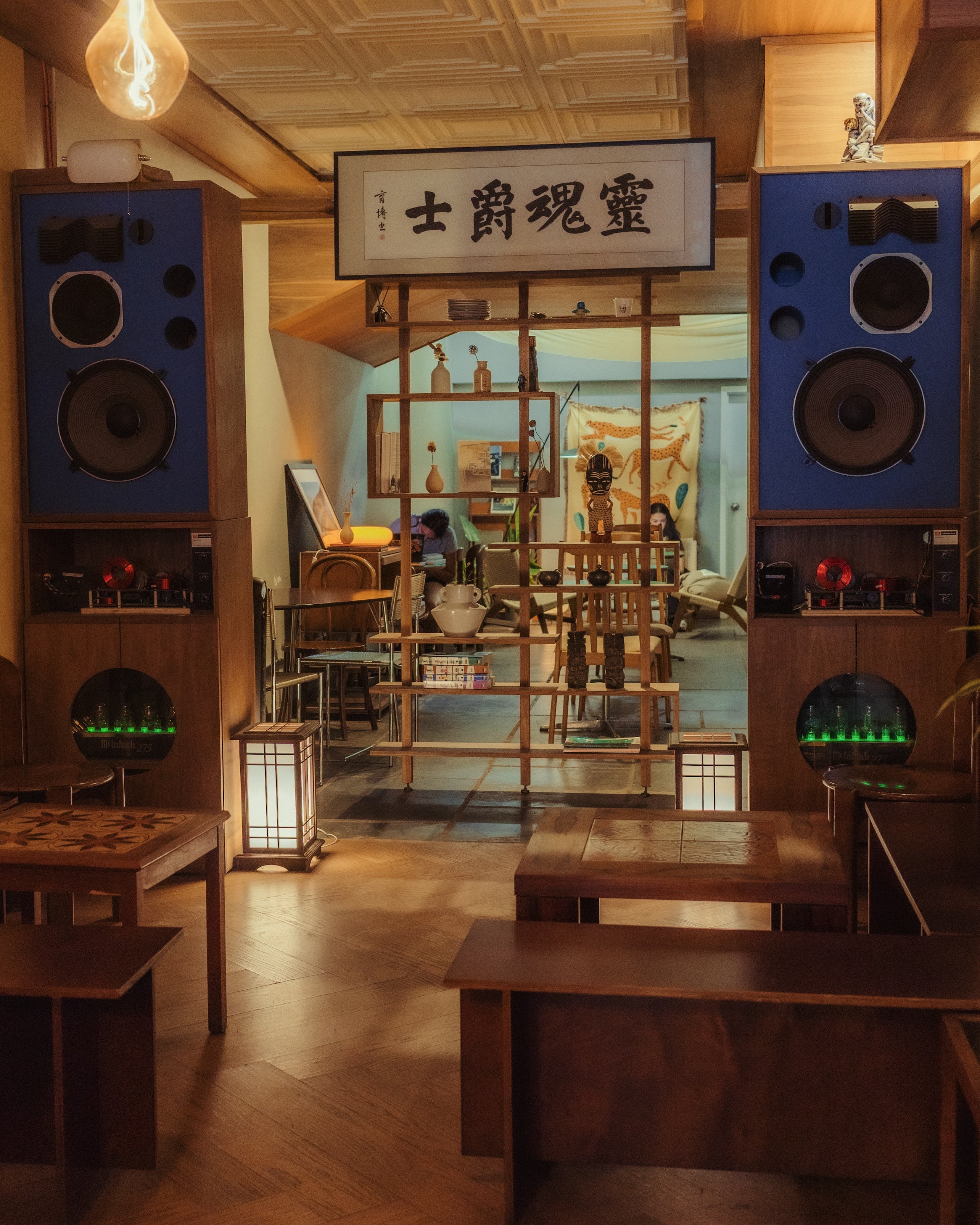
        <p>So there’s a whole market to remove the obligation (the agony and fear of not optimizing your precious time for the maximum aesthetic experience, especially while traveling!) of choice by offering a hip, curated space. Entering the room is the only choice you need to make. With this one action comes the gift of all the subsequent decor, music, ambient lighting, typography, food, and images for a holistically beautiful time. For instance, in Toronto, Jacob and I revisited an “Asian inspired” <span class="hover-img">coffee shop<span class="hover-img-card"> <img
                        src="https://roomscoffee.online/cdn/shop/files/ECK_3014.jpg"
                        alt="An image of a hip wood coffee shop">
         <span class="hover-img-caption">Rooms 17 Baldwin</span></span></span> and next door <span class="hover-img">Thai restaurant<span class="hover-img-card"> <img
                        src="https://kohlipe.ca/wp-content/uploads/2025/12/kohlipe-vibe-1.jpg"
                        alt="An image of a vibrant restaurant interior">
         <span class="hover-img-caption">Koh Lipe</span></span></span> because I had fun at both those places three months ago. I remembered discovering and flipping through a cool <span class="hover-note">arts criticism magazine<span class="hover-note-box"><a href="https://cmagazine.com/">C mag</a></span></span> that I assumed was Asian Canadian at the coffee shop and savoring the colorful, flavorful food next door. But revisiting both places left me with a great <span class="hover-note">sense of disappointment.<span class="hover-note-box">Jacob claims I only had a good time the first time around because it was a mid March snow, and everything is good when you can leave your house but still stay warm in a snowstorm.</span></span> Near the back of the coffee shop, I noticed wood veneer paneling haphazardly covering gas vents and thick linen tapestries hiding the overhead recessed lights. I ordered a yuzu honey tea which I swear was just hot water and the $9 2kg jar of Costco honey, citron & ginger tea mix that I finished a jar of, by myself, in 2022.</p>

        <p>With a wall full of “vintage” Japanese vinyl, furniture that I can only describe as midcentury modern if it was from the Qing Dynasty and not Scandinavia, and a beige <a href="https://roomscoffee.online/">website</a> that claims “thoughtful hospitality” and “moments of quiet connection” in a tiny serif typeface, the coffee shop could have been designed by the protagonists of Perfection. A few days prior, I was taken to a cocktail bar from the same franchise described as “hanging out in someone’s living room and not a bar” where I ordered a $19 non-alcoholic tea that <span class="hover-note">probably had<span class="hover-note-box">My memory isn’t great but the ingredients are interchangeable to the point being made.</span></span> sichuan peppercorn or matsutake essence. </p>

        <p>Look: I do think Asiaslop is what is keeping the middle class US-Canada economy alive (e.g. Molly Tea, Somi Somi, Miniso, etc.). I like spending my Labubu-amount-sized cash at these places for a little treat. I guess I just get suspicious, and just a little bit mad, when I feel like these “elevated” “insane vibe” places are being dishonest. Most stores exist to turn a profit, but these ones don't sell goods as much as they sell to patrons an image of themselves and their “discerning” taste. Seeing all the AI generated fractal food sidewalk adverts was only put me in a minorly worse mood, but I felt like at least I could more clearly understand the owners’ intentions. Even <span class="hover-note">dive bars<span class="hover-note-box">such as Japas, which markets itself more as a Japanese tapas restaurant, is a favorite of Jeff’s, and now has a special place in my heart as well</span></span> sell an image: granted, with their bricolage of dartboards, beer ads, and menus that feature a new font prepackaged with Microsoft Word (e.g., Curlz MT) on each page, an unpretentious image. I find this lack of concern with aesthetic freeing. But maybe that just makes me the target customer. </p>

        <p>But back to the aesthetic versus ethical life. Since Either/Or (Kierkegaard’s, not Batuman’s) kept popping up in my life, I figured I might as well actually try to read the primary source, which was the beginning of my week long side quest to acquire a physical copy. But how embarrassing is it to go to a bookstore as a non-white man and ask the clerk, “oh, do you have Kierkegaard?” Usually I asked where the philosophy section was, hence grabbing (and quoting from above) <span class="hover-note">Slavoj Žižek’s Like a Thief in Broad Daylight.<span class="hover-note-box big">which I also thought would help research into the graphic novel. But the part where he’s like young people are making up more and more “radical” sexualities because they have too much freedom in America, just like how the author of <a href="https://www.theatlantic.com/magazine/2026/09/elite-academia-leadership-hypocrisy/687969/">the recent Atlantic piece</a> about leaving Bates College basically had the vibe that he thinks there should only be two genders, I find really funny.</span></span> I had a brief crisis about my “normie” “alt” reading preferences when I stepped into Flying Books and saw my bookshelf <span class="hover-note">looking back at me.<span class="hover-note-box">But why, then, when a similar thing happened at Drawn and Quarterly two years ago, did I welcome it and declare D&Q one of my favorite North American bookstores!?</span></span> Finally, reading my new (to my dismay) Penguin Classics copy acquired from Black Squirrel in Ottawa, I found the introduction to describe Kierkegaard a bit like Marty Supreme (one of the movies I watched on my many flights, which I thought overly rewarded a boyish <span class="hover-note">entitlement<span class="hover-note-box big">By the way, I’ve been kind of getting into Jungian analysis. I know nothing about it, but Kai Cheng encouraged me to think about the “shadow” and what I most despised in others, which I said, after a brief pause, was entitlement…in case all the insecure footnote qualifiers haven’t already made that obvious. Then she asked what would it mean if I was at peace with entitlement in myself, and my brain truly hit a wall at that. Anyway, if you can teach me about Jung, please reach out!</span></span> possible only through whiteness). I also learned that when he wrote Either/Or, he was a year younger than me. 
</p>

<p>In my teens I found myself drawn to an aesthetic life, but it was because I felt like an outsider. I always loved to draw, and the world of images drew me. There is something about an image that is untouchable. If my peers could simply not understand my interiority due to (what I now perceive to have been, but certainly did not have the language at the time) racial, gendered, and class-based differences of experience, if I could not connect to others, at least I could curate a Tumblr blog. At least I could look cool online, where others knew none of the baggage of my identity. At least I could express myself and my superior “taste” and gain admirers whom I could pretend were friends. At least my aesthetic sensibilities, like those of the protagonists of Perfection, could protect me from critique, humiliation, and the terrifying fear—but desperate want—of being known. </p>

<p>I had a clarifying moment a few months ago reading <a href="https://www.inventorypress.com/product/seeing-making-room-for-thought">Seeing <—> Making | Room for Thought</a>. The authors argue that <b>the image can act as a bridge between embodiment and politics</b> (and I extend “the image” to also accompany the discussion of “aesthetics” above). That is to say, images can transform what I called earlier the “baggage of identity” (one’s unique, situated experiences and perspectives in the world) towards a more universal political commitment—images aren't just aesthetic fodder, but they can <span class="hover-note">also inspire others to live ethical lives<span class="hover-note-box">The thing is, I use the “not only… but also…” grammatical construction a lot, but I try to less now because of LLMs. Another thing they’ve taken from me…</span></span>. This helped explain my gripe: when people employ images solely for aesthetic reasons, often to increase consumer activity or bolster a personal brand, I yearn instead for them to say something political.</p>

<p>Let’s first talk about embodiment. Walter Benjamin talks about the <span class="hover-note">“aura”<span class="hover-note-box"><a href="https://web.mit.edu/allanmc/www/benjamin.pdf">Walter Benjamin, The Work of Art in the Age of Mechanical Reproduction</a></span></span> of a work of art as something intrinsic in the original artwork that reproductions (often in the forms of images, like taking photos of paintings in museums) fail to capture. But reproductions can capture some sense of embodiment. Photographs, in particular, capture a slice of time when the photographer presses the shutter. I look at a photograph and feel some kind of sensory vibe from the moment of <span class="hover-note">capture,<span class="hover-note-box">And compared to a graphic novel, it’s so much less labor to get to that feeling with a photo…</span></span> even if I was not there, or even if I don’t know the photographer.</p>

<p>Social media has made sharing images, which often lose their provenance, very easy. In the age of generative AI, this loss of provenance (and thus credit and power) is obviously a big problem for artists. But I would argue that the death of the author is what make images powerful and able to “motivate the will” and serve as a <span class="hover-note">“medium for the transmission of material reality.”<span class="hover-note-box"> Buck-Morss et al., Seeing <—> Making | Room for Thought. Room 4, Visual Studies & Global Imagination.</span></span> Though earlier I said that images can relay an author’s baggage of identity towards political commitment, images—particularly those that could have been taken by anyone—can also strip it away. </p>

<p>Images are the <span class="hover-note">universal language.<span class="hover-note-box">ibid. Room 1, The "How" of Knowledge.</span></span> When we travel but cannot speak, we can still recognize a beautiful landscape, a restaurant queue, a safe space to rest. When we return home, images let us share these embodied experiences to tell our loved ones that we were enriched by the trip, by the new sensorial pleasures and observing others’ ways of life—how different, yet the same, we all are, through this common language of images.</p>

<p>But to me, it can’t just stop at aesthetic appreciation. I obviously haven’t finished Either/Or, so you can check back in a few months, but my layman's understanding is than an ethical life is one that has a responsibility to others. (I think Kierkegaard’s critique is that that means a responsibility to bourgeois institutions and maintaining status-quo social order, e.g. through the state or marriage, which I obviously share.) Having developed the ability to make meaningful social relations as an adult, or at least the language to articulate my identity, thus erasing my self obsession and freeing up my energy to pursue endeavors I deemed more interesting—more “ethical”— because they were larger than myself—was probably the <span class="hover-note">second biggest change<span class="hover-note-box">The first was moving to the US.</span></span> in my life. That’s the “political” part of how images bridge embodiment and politics. Images can inspire commitment. Through their universalization (“abstraction,” as we computer scientists like to say) a person’s unique, situated embodied experience can be felt and so resonant it spurs the imagination towards a different future. (Or, at least, social media slacktivism.) And even if all we do is collect and rearrange existing images, instead of creating new artworks, this also has political power: when montaged, images take on a new context. Like how writers can move around chunks of time, artists can juxtapose images to imbue new meaning to an image’s existing narrative and <span class="hover-note">“educate and awaken” <span class="hover-note-box">ibid. Room 5, The Task.</span></span> their viewers.</p>

<p>This ties back to the graphic novel project because my whole life has been speaking the language of images, before I was able to articulate my feelings with words or academic theory. <span class="hover-note">“The meaning of artworks is the intention of the artist. The meaning of the image is the intentionality of the world.”<span class="hover-note-box"> ibid. Room 4, Visual Studies & Global Imagination.</span></span>  As an artist, I want to speak in images to create artworks. The graphic novel feels like a commitment to fighting, however I can, the battle against the Project of AI. This feels like the art I am driven to make because of an inward sense of duty, or my social responsibility afforded by my unique position in the world, rather than a conformity to rules, or, as was my teenage motivation, putting on an aesthetic armor to shield me from vulnerability (and thus criticism). </p>

<p>I think developing a political orientation and commitment (beyond the commitment to consumerism) is the missing piece in a lot of the images (like that coffee shop) I encounter. Near the start of calling myself a <span class="hover-note">“full time artist”<span class="hover-note-box">Which still means supervising research projects :)</span></span> I had some kind of romantic notion of working in a new cafe each day as the change in environment and/or people watching might have “done something” for me creatively. But in the end I was so in my own head it didn’t really matter where the work got done. This was probably because I didn’t talk to anyone other than to <span class="hover-note">place an order,<span class="hover-note-box big">My first hot take for this post is that non-dairy milk should be default for a drink and dairy milk should be extra. I’m lactose intolerant, and wouldn’t a cow be more expensive than an oat field? But then a quick search made me learn that it is actually more expensive to produce oat milk than cow’s milk because of the processing steps…</span></span> and that I didn’t go back to any place enough times to form any kind of meaningful connection with the people there. In this way, I lived the aesthetic life where others are objects for my observational pleasure.</p>

    </div>
</section>

<section class="aaa">
    <div class="content">

        <h2>On being an Asian American in Asia</h2>

        <p>
            I’d like to offer the previous point (treating others’ lives as accessories without knowing their interiority) to supplement the critiques of <a href="https://en.wikipedia.org/wiki/Boba_liberal">boba liberalism</a> or <a href="https://letterboxd.com/furyroad/film/past-lives/">cut fruit diaspora </a>. Consider this collection of photos: baby chicks spilling over a morning market basket; the sloping roof of a pagoda that guides the viewer’s eye along the top of a tranquil lake, framed by the rule of thirds, to the suggestion of morning fog; broken glass on a cobblestone courtyard no one is in a hurry to clean up; leather skinned uncles squatting around a public checkers table sporting a cigarette in one hand and pulling up their Beijing bikini with the other. Consider it posted on the IG grid of a member of the Asian North American diaspora who has returned to see the homeland. What is it for? Clout? Novel sensory pleasure? Without a political commitment, is all there is to externalize about one’s heritage aesthetics and snacks? Is it a fear of vulnerability that chooses to post tea houses hidden in the high pines, rather than the just as universal experience of hanging out with extended family? Where are the aunties and uncles? Do they not fit into Western aesthetic norms? Is the diasporic child estranged, or, more likely, grappling with their own shame? 
        </p>

        <p>I don’t want to be vitriolic or ungrateful. It’s fine to live an aesthetic life. And ultimately it doesn’t matter that I spent $19 on a tea or saw behind the wood veneer, because I had fun talking to and learning more about people in those spaces. My three week trip to East and South East Asia was because of my privilege and work as an academic. To the HCI research community who committed to hosting me, I hold a great gratitude. I saw no family, but I offer these vignettes (a photo montage, if you will...) with friends: </p>

        <ul>

              <li>Vann drove me, in addition to all over the Eastern Taiwan coast, to a very good mountain tea house called <a href="https://share.google/UpgGYqNs0oxjSNMpf">東昇茶行</a>. After speaking one sentence, the owner mistook my accent to mean I was from Hong Kong (she was the third person who said so this trip, but I had also never gotten this before this trip). After I corrected her and we chatted about (i.e. she bragged about) how a former shop patron bought <span class="hover-note">$10k NTD<span class="hover-note-box">roughly $3k USD</span></span> worth of tea to carry with her to Australia, refusing to drink anything else, she said my <span class="hover-note">國語<span class="hover-note-box">Taiwanese Mandarin</span></span> was good for living in the US for so long. I knew this as a classic sales ploy, and felt both satisfied to have not disappointed her so she could at least dole out a compliment (regardless of ulterior motive) and a little confused…my whole trip had been, as a mainlander who only speaks <span class="hover-note">普通话<span class="hover-note-box">Mainland China Mandarin</span></span>, listening to Taiwanese people talk to each other quickly with a dizzying lack of comprehension. Anyway, I’m totally obsessed with cold steeping their green pomelo tea, which is <span class="hover-img">beautifully packaged among two stretching cranes.<span class="hover-img-card"> <img
                        src="http://dsts.com.tw/uploadfiles/prodimg/17213145965ab04e_02.jpg"
                        alt="A bright green packaging with two cranes">
         <span class="hover-img-caption">Via their <a href="https://dsts.com.tw/paper_3.php">website</a>.</span></span></span> 
          (Hot water makes the leaves overpower the delicate and sweet pomelo notes!) As I sampled a cup that was steeped for five days, the owner smiled and told me to make sure to <span class="hover-note">share the tea<span class="hover-note-box">I bought individual bags to share, so if you ever want to try any, let me know the next time we hang out!</span></span> with my parents: they’ll swear you added honey.</li>

            <li>I really enjoyed talking with the KIXLAB, who insisted on Jane and I trying “Korean style boba” (which I didn’t think was that different than other kinds of boba) and visiting KAIST’s duck pond. After kindly being driven there so we wouldn’t miss our train back from the detour, the birder in me had to correct them that I saw one mallard and a dozen geese, so it should be called the goose pond. But this <a href="https://www.kaist.ac.kr/newsen/html/news/?mode=V&mng_no=47530">news article</a> calls it the KAIST Duck Pond, so I fear I was being overly pedantic.</li>

            <li>The final day of the UIST PC meeting, I found myself with other Chinese and Korean diaspora colleagues discussing our lives across the Pacific. We all probably went to Asia more than the average North American immigrant (one was doing a sabbatical in China, one returned to be a professor in Korea, one’s parents lived here)—I guess it made sense since we chose to do the in-person meeting in Seoul instead of the North American location. We talked about the evolutions of Mandarin and Korean words, the <span class="hover-note">differences between growing up Asian in the States versus Canada,<span class="hover-note-box big">I read a Tweet somewhere that Asian Americans assimilate more to white supremacy because there are fewer Asians around, while Asian Canadians just find and hold onto other neighboring Asian families.</span></span> and 辈字, a family poem used for naming each generation of Chinese children. We ordered too much bingsu. My former labmate who moved back to Korea made a joke about not wanting to travel to the US on July 4th, the nation’s 250th anniversary, out of fear of becoming, himself, a firework. This all felt immensely healing to my spirit. Never in high school would I have ever thought to have this kind of conversation! </li>

             <li>In Singapore, Ace and Isabel led Jane and I along various dim mall corridors to cool independent bookstores and <a href="https://www.instagram.com/catalogco/">shops with rotating vending artists</a>. My favorite place was the <a href="https://casualpoetlibrary.com/">Casual Poet Library</a>, where anyone can rent a personal cubby to curate books, crafts, and whatever other treasures library members may check out. I look forward to many revisits (and hopefully volunteering as a librarian!) in 2027.</li>


            <li>I also went to Craft Festival Singapore, which surprised me by having way more Pokémon fan merch than most Artist Alleys I’ve been to in North America. Actually, even popular souvenir shops along tourist streets were selling local artists’ merchandise of Nintendo franchises. I feel like Nintendo’s lawyers would have struck this down immediately in the US. Compared to the kinds of independent artist/small press events in North America, where I usually feel a frustration around <span class="hover-note">selling one’s personal identity,<span class="hover-note-box big">My second hot take is that zines were originally made to cheaply disseminate often political information, but nowadays people are charging $25 so we can read 16 pages on how it is hard to be queer and white.</span></span> I thought these vendors (which came from all over South East Asia) focused more on selling works related to global fandoms and “mass market appeal” rather than personal identity (e.g., no colored frogs of every pride flag variation). Watching the play <a href="https://www.wildrice.com.sg/event/472273-girls-girls-girls/">Girls Girls Girls</a> taught me that in Singapore, marriage is basically a housing transaction, since only married couples qualify for the BTO lottery (new subsidized housing flats). Since same-sex marriage is not (and likely never will be) <span class="hover-note">legalized,<span class="hover-note-box big">Contrast to me reading Dean Spade in my freshman year queer theory class, where I viewed US marriage equality as neoliberal fodder.</span></span> for queer Singaporeans, “life starts at 35” (a line from the play) when you can enter the single’s lottery. If I had to live at home with my parents until I was 35, especially given that many Asian cultures respond to queer- and trans-ness with at best not acknowledging it and at worst violence, I would be living as a completely different person.</li>
        </ul>

       <p>Nowadays, I genuinely do not feel marginalized in my material conditions or through a systemic denial of <span class="hover-note">opportunity.<span class="hover-note-box">Because of my tenure-track job! It’s just my life—not the lives of other queer US Asians—right now.</span></span> My experiences with marginalization have created some kind of spiritual need to <span class="hover-note">meaningfully redistribute the power<span class="hover-note-box big">The student conversation I remember the most was one who wanted to do research supporting queer communities, but was worried publishing would single them out in an unsafe institution.</span></span> I have obtained in this world. I recently learned from my dad that the reason why we moved to California (from rural Connecticut, after he finished graduate school) was that he was tired of feeling like a foreigner, and if he took his family to a place with more Asian people, maybe he wouldn’t be such a minority. Hearing this made me pause. I am always thinking about race. The fact that my father, whom I had categorized as more “Chinese” than my “American,” had these thoughts almost 25 years ago, a time where my racial understanding was that I loved watching Michelle Kwan on TV because I could see myself in her…I hadn’t given him nearly enough credit.</p>

       <p>He also recently joked that I probably would not have scored high enough on the 高考 to have been admitted to a top Chinese University, which made me realize maybe the Chinese American dream isn’t to send your kids to an Ivy League college so they can <span class="hover-note">pursue prestige<span class="hover-note-box big">My final hot take of this post is that to combat the critiques of the MFA-ication of creative writing (background: read <a href="https://www.thegeorgiareview.com/posts/hatchling/">Hatchling</a>), Asian Americans need to embrace the cultural taboo of humiliation. To me, this manifests as crude sexual perversity. Examples I love: the short story Ahegao in Tony Tulathimutte’s Rejection, the comic about the call operator in Michael DeForge’s recent All the Cameras in My Room, Jenny Zhang’s Sour Heart.</span></span> and justify your “sacrifice,” but rather to give them the freedom to develop as people instead of grinding problem sets from age 11. The summer before senior year, my parents sent me fto SAT bootcamp, which felt like the ultimate humiliation at the time (my memory of that era is mainly playing The Tallest Man, the Broadest Shoulders on repeat from an Illinoise CD I burned myself as I drove to and from the strip mall). But it could have been so much worse. Most of my time in <span class="hover-note">high school<span class="hover-note-box">Also I feel like I’ve written a lot about my high school self in this post, but I promise I don’t actually spend any time thinking about that era in my life. It has just come up here!</span></span> was spent dicking around on InDesign or influencing my friends in orchestra about how cool Andrew Bird was.</p>

       <p>When I vacationed in Jeju Island for two days after the UIST PC meeting, it was so beautiful I could feel the stress of the previous two academic weeks dissipate in the salty sea breeze. “I fear I was born to be on an island,” I thought, very well knowing if that was actually my life circumstance I would want nothing more than to leave and see the world around me. My time in the Great Lakes region left me a little itchy because I could not see any <span class="hover-note">mountains in the distance.<span class="hover-note-box">You can humiliate me all you want for being a Californian. As I learned from a friend from Virginia, I think people just like the landscapes they grow up with.</span></span> But on Jeju Island, there was always a mountain—and vibrant hydrangea bushes, at the peak of their late June blossom—to accompany me.</p>

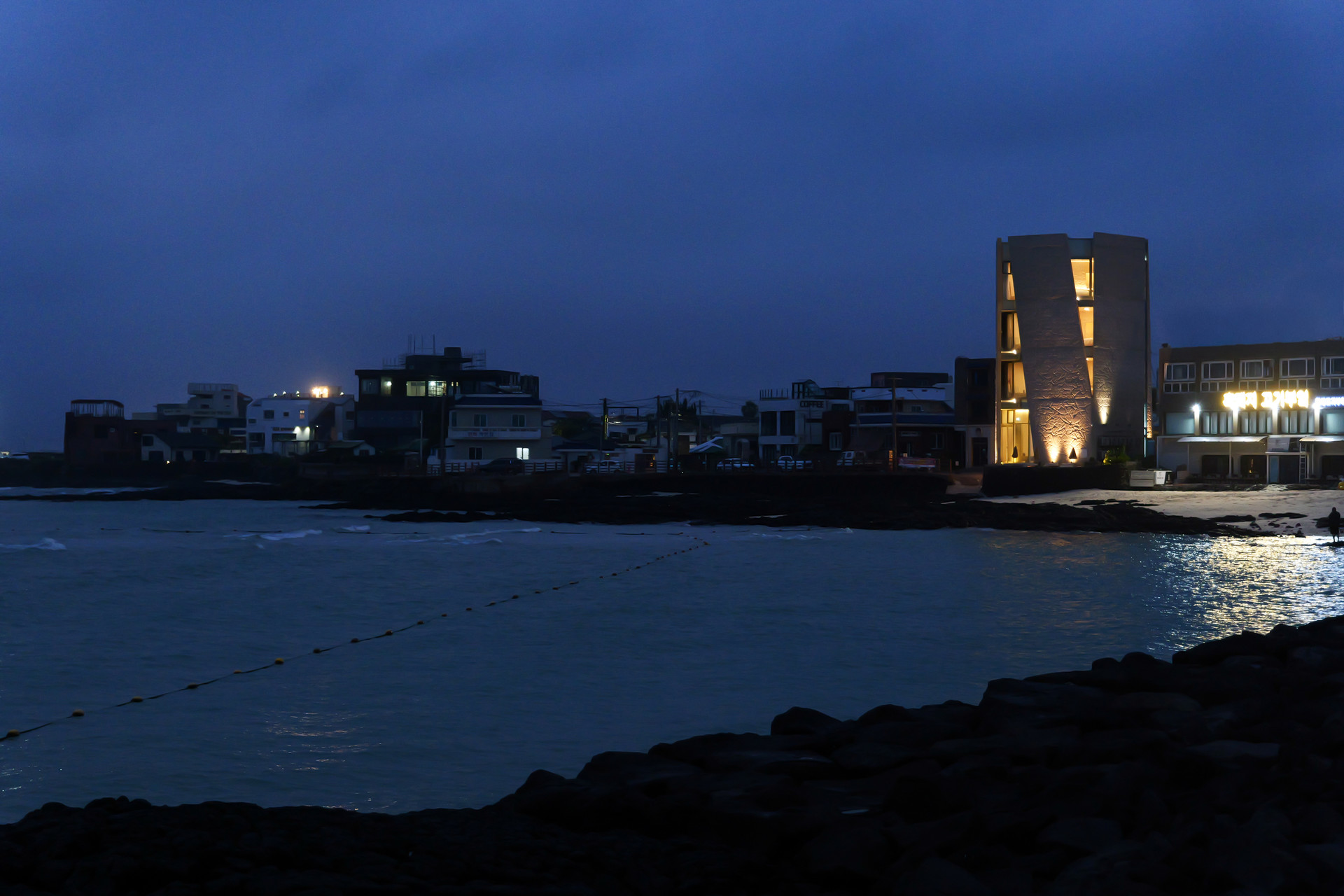
       <p>When we checked into our hotel, I felt both giddy and a little like I had done something wrong. I had never been in anything quite as aesthetic. The hotel, <span class="hover-img">a striking cylinder of plaster that had been extruded and twisted,<span class="hover-img-card"> <img
                        src="https://cdn.imweb.me/thumbnail/20250911/9705e6ebb6ff1.jpg"
                        alt="A bougie hotel on the beach at night"> <span class="hover-img-caption">Via their <a href="https://en.atarakjeju.com/gallery">website</a>.</span></span></span> was on the shoreline of one of Jeju's most popular beaches. It opened less than a year ago and smelled strongly of new construction, particularly in the elevators where the diffused essential oils could not penetrate. 
      Our room's ocean-facing window was aligned with the trajectory of the sun, and the <span class="hover-img">huge soaking tub<span class="hover-img-card"> <img
                        src="img/view.png"
                        alt="A bath, a window, an ocean, and a sun, all in a straight line from the camera lens."><span class="hover-img-caption">This is purposefully the only image of mine in this post.</span></span></span> in front of the window was the perfect place to privately admire the sunset. The only other guests I saw in the hotel were a wmaf couple. As Jane left in search of a swimsuit, I changed into mine, and was surprised to see a glimpse of radiant skin—a fraction of a second later, I realized I was looking at myself. At golden hour, a sunbeam filtered in through the giant window and landed exactly in front of the full length mirror. I realized that moreso than watching sunsets, the window placement was optimized for taking thirst traps. How could I forget: that the body is the first and final frontier to be aestheticized. </p>
    </div>
</section>

<section class="etc">
    <div class="content">

        <h2>From last time</h2>

        <p>
           Jacob and I went to see a play, Six Trees, at Toronto Fringe Fest co-written by and starring their coworker’s wife. It was partially inspired by her and her friend the director’s experience grieving a giant elm that succumbed to <span class="hover-note">Dutch elm disease.<span class="hover-note-box">Fun fact: Claremont, at Memorial Park, apparently has one of the healthiest and oldest elm groves in California.</span></span> The director mentioned the large stump was the street north of Christie Pits Park, so while walking up the park’s east end to find it, we stumbled upon an ice cream truck. It was an Aveeno truck, serving free scoops to promote their new vanilla bean oatmeal and berry scented body lotions. I felt soooo validated.
        </p>

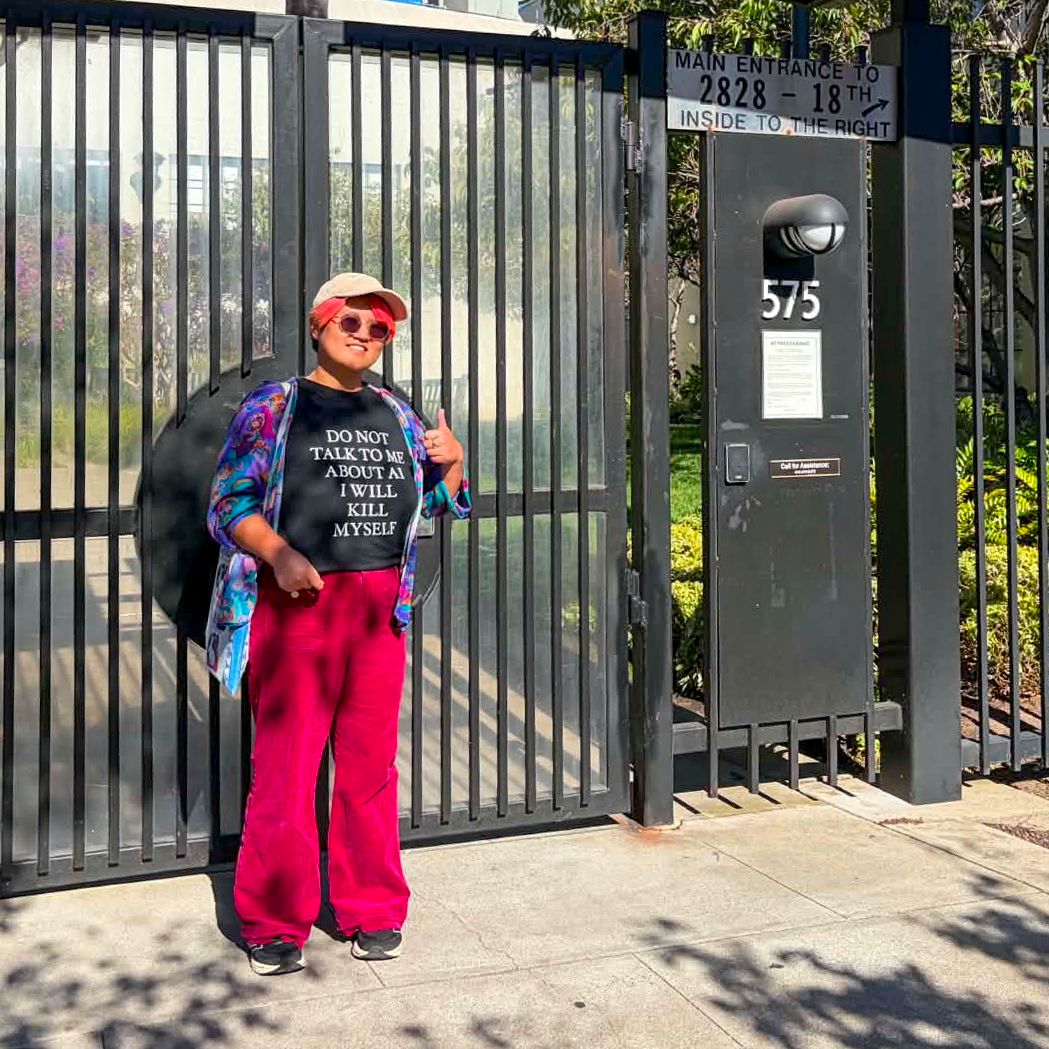
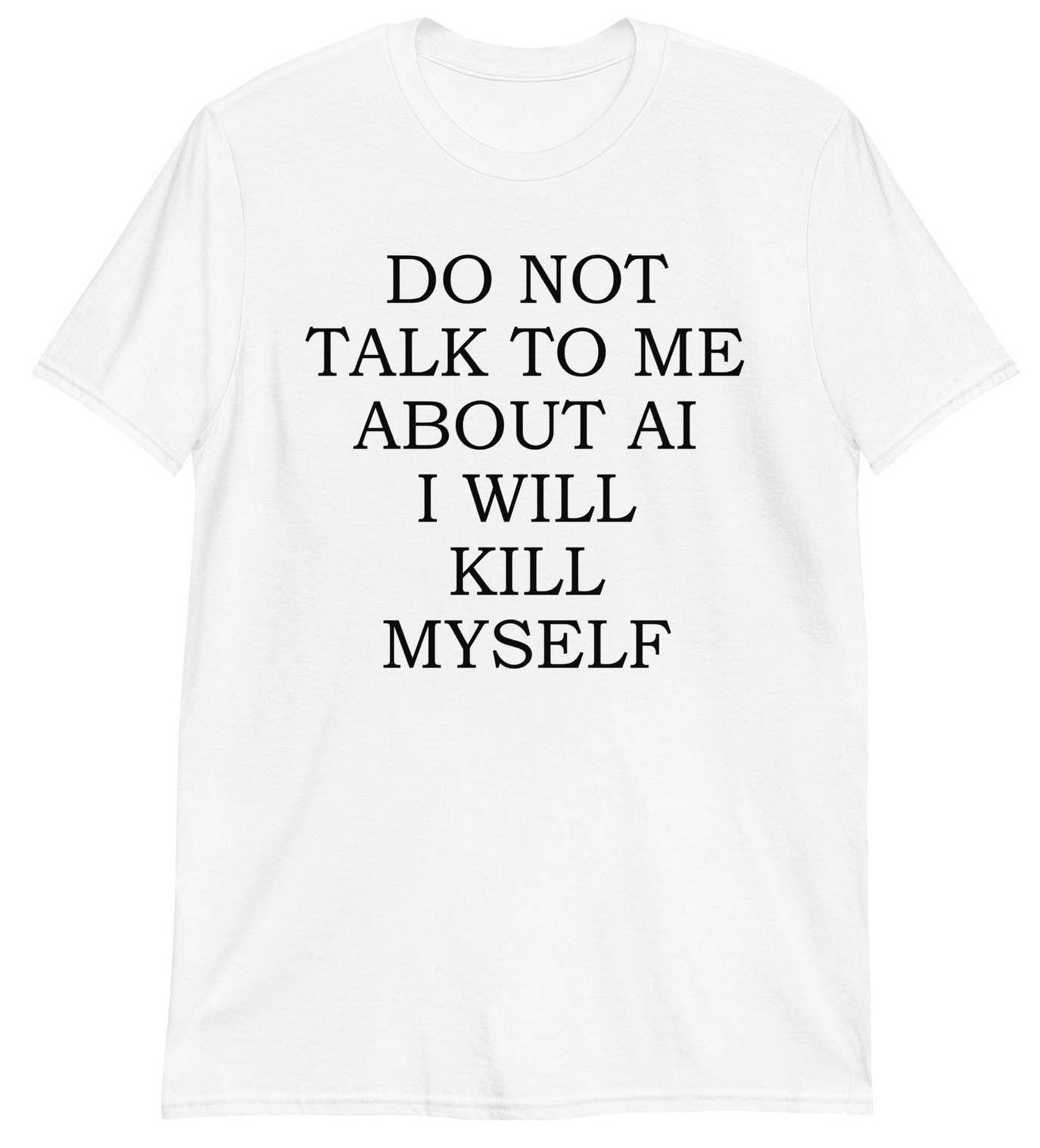
        <p><span class="hover-img">I bought the shirt.<span class="hover-img-card"> 
       <img src="img/ai-shirt-2.png"
       alt="Myself wearing a shirt that says, Don't talk to me about AI I will kill myself"><span class="hover-img-caption">Photo by Mitchell, who thought it would be funny to take in front of the OpenAI finance office.</span></span></span></p>

        <p>
            I’m excited to spend my birthday watching a <a href="https://magwest2026.sched.com/artist/silvagunner.2a0surl5">SiIvagunner set at Magwest</a> in San Jose this weekend! Aivi & Surasshu (of Steven Universe fame) are performing earlier in the day too. This is an open invite if you would like to join.
        </p>
        <h3>Advice column</h3>
        <p>Alan asks, <i>What should I put in my office as a new prof?</i> Given the discussion about the image in this post, I think your office decorations should communicate something about you that students may be too shy to ask. For example, I have 
         <span class="hover-img">this poster<span class="hover-img-card"> 
       <img src="https://housewarmings.store/cdn/shop/files/stay-positive-187241.jpg"
       alt="A poster of a happy face with happy face sunglasses that says, Stay Positive"><span class="hover-img-caption">For sale <a href="https://housewarmings.store/products/hw1012">here</a>. I went in a brief episode of second guessing myself because I swear there was a single tear under the sunglasses. Of course, I am nowhere near my office, so I can’t check.</span></span></span>
        framed on my wall. I’m for taking the various plushies and tchotchkes in your house and delegating some for the professional sphere, if it does not disturb the current interior peace. (Congrats on the job, Alan, and good luck to folks on the market this year! <a href="https://academicjobsonline.org/ajo/jobs/32241">Pomona is hiring.</a>)</p>

        <p>As always, <a href="https://forms.gle/rdsuF2j2pkcPuvnx9">(un)subscribe here</a> and <a href="https://forms.gle/dchtoopBNZ5KVQvy9">ask questions here</a>. Thank you for reading! It was a long one.</p>

        <p>Until next time,<br/>
        Jingyi</p>

        <p><a href="./">&larr; back</a> • vol 2</p>

    </div>
</section>

      <script>
        const toc = document.getElementById('toc');
        const tocContent = document.getElementById('toc');
		ol = document.createElement('ol');
		document.querySelectorAll('section').forEach((s, i) => {
		   const h = s.querySelector('h2');
		   if (!h) return;
		   if (!s.id) s.id = 'sec' + i;
		   const li = document.createElement('li');
		   li.innerHTML = `<a href="#${s.id}">${h.textContent}</a>`;
		   ol.appendChild(li)
		});
		tocContent.appendChild(ol);
		let last = scrollY;
		addEventListener('scroll', () => {
		   const y = scrollY;
		   if (y > last + 5 && y > 100) toc.classList.add('hidden');
		   else if (y < last - 5) toc.classList.remove('hidden');
		   last = y;
		});

		document.getElementById("toc-close").addEventListener("click", e => {
	        toc.classList.add("hidden");
	    });

		document.querySelectorAll('.hover-note').forEach(n => n.addEventListener('click', e => {
		   e.stopPropagation();
		   document.querySelectorAll('.hover-note.active').forEach(x => {
		      if (x !== n) x.classList.remove('active')
		   });
		   n.classList.toggle('active');
		}));
		document.addEventListener('click', () => document.querySelectorAll('.hover-note.active').forEach(n => n.classList.remove('active')));
		document.querySelectorAll('.hover-note-box').forEach(b => b.addEventListener('click', e => e.stopPropagation()));

		document.querySelectorAll('.content a').forEach(link => {
		  link.setAttribute('target', '_blank');
		  link.setAttribute('rel', 'noopener noreferrer'); 
		});

      </script>
   </body>
</html>]]></content><author><name></name></author><category term="sabbatical-blog" /><summary type="html"><![CDATA[what's jingyi doing on sabbatical • vol 2]]></summary></entry><entry><title type="html">what’s jingyi doing on sabbatical • vol 1</title><link href="https://jingyi.me//sabbatical-blog/one.html" rel="alternate" type="text/html" title="what’s jingyi doing on sabbatical • vol 1" /><published>2026-06-03T00:00:00+00:00</published><updated>2026-06-03T00:00:00+00:00</updated><id>https://jingyi.me//sabbatical-blog/one</id><content type="html" xml:base="https://jingyi.me//sabbatical-blog/one.html"><![CDATA[<!DOCTYPE html>
<html>
   <head>
      <meta charset="utf-8">
      <meta name="viewport" content="width=device-width,initial-scale=1">
      <title>what's jingyi doing on sabbatical • vol 1</title>
      <link rel="preconnect" href="https://fonts.googleapis.com">
      <link rel="preconnect" href="https://fonts.gstatic.com" crossorigin>
      <link href="https://fonts.googleapis.com/css2?family=Arvo:wght@400;700&display=swap" rel="stylesheet">

      <style>
        :root {
			--paper: #FAF0E6;
			--horizons: #fad4b2;
			--youch: #dfb296;
			--text: #3c3633;
			--muted: #8A7D75;
			--border: #95807b;
			--link: #8c4d65;
		}

		* {
			box-sizing: border-box;
		}

		html {
			scroll-behavior: smooth;
		}

		body {
			margin: 0;
			background: var(--paper);
			color: var(--text);
			font: 400 18px/1.9 Arvo, serif;
		}

		section {
			padding: 2rem 0;
		}

		.content {
			max-width: 760px;
			margin: auto;
			padding: 0 1.5rem;
		}

		h1,
		h2 {
			font-weight: 700;
		}

		a,
		a:visited {
			cursor: pointer;
			color: var(--link);
			text-decoration: none;
			border-bottom: 1px dotted currentColor;
		}

		ol li, ul li {
			padding-left: .75rem;
		}

		ul li {
			margin: 1em 0;
		}

		.how-things-can-be {
			background-image: linear-gradient(var(--paper), var(--horizons));
		}

		.hot-takes {
			background-image: linear-gradient(var(--horizons), var(--youch) 25%);
			color: #201d1b;
		}

		.hot-takes a {
			color: #633647;
		}

		.etc {
			background-image: linear-gradient(var(--youch), var(--paper) 5%);
		}

		.date {
			padding-top: 8rem;
		}

		#toc {
			position: fixed;
			top: 1rem;
			right: 1rem;
			width: 300px;
			background: rgba(255, 255, 255, .67); /*haha 67*/
			backdrop-filter: blur(2px);
			border: 1px solid var(--border);
			border-radius: 8px;
			padding: 1rem;
			transition: .25s;
			z-index: 48;
		}

		#toc-close {
		    position: absolute;
		    top: .45rem;
		    right: .55rem;
		    color: var(--muted);

		    border: none;
		    background: none;

		    padding: 0;

		    font: inherit;
		    font-size: 1rem;
		    line-height: 1;
		}

		#toc.hidden {
			opacity: 0;
			transform: translateY(-20px);
			pointer-events: none;
		}

		#toc ol {
			margin: 0 0 0 1rem;
			padding: 0;
		}

		#toc li {
			margin: .4rem 0;
		}

		#toc a {
			color: var(--text);
		}

		.hover-note,
		.hover-img {
			position: relative;
			border-bottom: 1px dotted currentColor;
			cursor: pointer;
		}

		.hover-note-box,
		.hover-img-card {
			position: absolute;
			left: 50%;
			top: calc(100% + 12px);
			transform: translateX(-50%);
			width: min(340px, calc(100vw - 2rem));
			background: #fff;
			border: 1px solid var(--border);
			border-radius: 8px;
			overflow: hidden;
			padding: .9rem;
			opacity: 0;
			visibility: hidden;
			transition: .15s;
			z-index: 47;
		}

		.hover-note:hover .hover-note-box,
		.hover-note.active .hover-note-box,
		.hover-img:hover .hover-img-card {
			opacity: 1;
			visibility: visible;
		}

		.hover-img-card {
			padding: 0;
		}

		.hover-img-card img {
			display: block;
			width: 100%
		}

		.hover-img-caption {
			display: block;
			padding: .8rem .9rem;
			color: var(--muted);
			font-size: .9rem;
		}

		@media(max-width:640px) {
			#toc {
				width: 250px;
				font-size: .85rem
			}

			.hover-note-box,
			.hover-img-card {
		        position: fixed;
		        left: 50%;
		        top: 90%;
		        transform: translate(-50%, -90%);
		        width: max(360px, calc(100vw - 2rem));
		        z-index: 47;
			}

			.date {
				padding-top: 12rem;
			}
		}
      </style>
   </head>
   <body>
      <nav id="toc">    
      	<button id="toc-close" aria-label="close">&times;</button>
      	<b>Table of Contents</b>
        <div id="toc-content"></div>
    </nav>
      
<section class="how-things-are">
    <div class="content">
        <p class="date">June 3, 2026</p>

        <h2>How things are</h2>


        <p>
            When my students ask me how I ended up as their professor the story usually starts with “in high school I wanted to be an artist, but in college I was forced to be an engineer.” I’m treating sabbatical as the opportunity to finally realize this high school dream. I talk with my brother (recent media studies master’s grad, looking for work) about how most art is made by “nepo babies” who have the privilege of pursuing self-expression without worrying about how the market will receive the fruits of their time. I talk with my friends about our immigrant generational duty to work so you can retire your parents and sponsor your kids’ art careers. But now I have a salary, a reasonable expectation from my employer about what kinds of “research” will be accomplished in a year without teaching, and the most time not pre-delegated to labor since I became an adult. More than just academically blurring the bounds of a “Computer Science Research Agenda” with a “Personal Artistic Practice,” I want to make silly comics and have fun. How lucky am I to have this stability to make art?! So, thanks parents, for forcing me to be an engineer even though I had no idea what that meant, and thanks Neopets/Geocities/<a href="https://lissaexplains.com/">Lissa</a>, for making me believe the HTML markup language was “computer science” so the field seemed accessible. 
        </p>

        <p>
            I’m writing this in a Vietnamese coffee shop in the Annex neighborhood of Toronto. A little less than a month ago, I taught my last class pre-sabbatical. A week and a half ago, I <span class="hover-note">moved out of Claremont.<span class="hover-note-box">
                    I'm actually surprisingly sad about this. Also, welcome to the hover annotations. If you click, they will stay.
                </span>
            </span> Four days ago, I attended the wedding of one my oldest friends whom I met online drawing Pokémon fan art when I was 10. When I first started this job, one of my biggest worries was returning to a Southern California suburb (the backdrop of much middle- and high-school distress). Actually, now, I’ll really miss my sunny LA life! It’s OK that Claremont is a panopticon and all my friends are my colleagues because I would rather have community and solidarity in the workplace than to brush up against those in power who mainly care about status and image. Whenever someone inevitably asks me about AI (I have considered buying <span class="hover-img">this shirt
            <span class="hover-img-card">
                    <img
                        src="img/ai-shirt.png"
                        alt="A shirt that says DO NOT TALK TO ME ABOUT AI I WILL KILL MYSELF">
            </span>
            </span> several times), I have begun to say that AI has ruined my life. But how lucky am I to be in a computer science department in which a majority view it with skepticism? That bought a book about <a href="https://www.penguinrandomhouse.com/books/743569/empire-of-ai-by-karen-hao/">how OpenAI is a modern day colonizer</a> for our department library? Going from the belly of Silicon Valley to a liberal arts college was what I needed to heal. I’m not even extremely disillusioned with research anymore! I have so much academic freedom and support, I feel recognized for my efforts in and out of the classroom, and I am so proud of my students! What a treat it is to have, largely, a healthy workplace. And what a treat is it to step away. 
        </p>


        <p>
            At one of the various end-of-semester receptions I attended before commencement, I started to talk about my pro-Claremont opinions. This turned the heads of the people around me because we all love to gossip about and judge place, potentially from a fear of becoming irrelevant in the suburbs. As my friend Jordan has said, when you consider “Claremont” to be a 20 minute driving radius, your world really expands (and obviously leagues more with an hour radius by car or Metro—which I can now bike to in 10 minutes now!). Because I don’t gate keep, some of my favorites experiences include eating <span class="hover-note">李家面’s 豆腐脑 <span class="hover-note-box">
                    For our non-Chinese readers, a soft and savory tofu dish at Seasons Cafe in Diamond Bar, found by my dad on XHS.
                </span>
            </span> weekends before noon, sitting under the big tree in Glendora, scrambling up the <span class="hover-note">short but steep trail at Mountain Ave 
                <span class="hover-note-box">
                    Jordan also told me about this, which is a much better alternative to Claremont Hills Wilderness Park.
                </span>
            </span> to see the hills at golden hour, and eating any <span class="hover-note">taco at or under $2.
                <span class="hover-note-box">
                    Such as Sundays at Tacolandia, which is in the parking lot of the Pomona Swap Meet, introduced to me by Char and Nikhil.
                </span>
            </span> Even though I was deeply disappointed by our recent poll results that showed how far Californians have to go in their fight against neoliberalism, big corporations, and real estate, I still love and believe in the state and the people in it who make it so special. If we have failed to achieve a progressive future that matches our state’s natural beauty it means we need to organize harder. As the late David Lynch said, the sun shines brighter in LA. When every day is backdropped by <span class="hover-note">beautiful blue skies and golden sunshine all along the way,
            <span class="hover-note-box">
                    Listening to David Lynch's daily weather report on KCRW during the COVID-19 lockdown really helped me.
                </span>
            </span> I can’t help but to be an optimist... 
        </p>
    </div>
</section>

<section class="how-things-can-be">
    <div class="content">

        <h2>How things can be</h2>

        <p>
            Since the start of my sabbatical (which I’ll pin to 2.5 weeks ago) I’ve been sleeping a lot. My friends like to say that I am very bad at sitting still and doing nothing. To make progress towards my non-academic creative projects, and to figure out what “life as an artist” even means on a material and concrete level, I try to follow these three daily goals:
        </p>
            <ol>
                <li>move body intentionally</li>
                <li>create no matter how bad</li>
                <li>engage with existing creative work</li>
            </ol>

        <p>Nowadays, #1 looks like jogging or taking 10k steps, #2 looks drawing or writing, and #3 looks like reading. I welcome any reader stories or advice for developing their creative routines. When I was in a slump in grad school during the height of the COVID pandemic, one of my mentors Christina gave me a <a href="https://jessicaabel.com/growing-gills/">book her friend wrote about creative project management</a>. This got me to think that working on creative projects and doing HCI research were kind of a similar meta-process, so I’ve been just riding on my existing academic skills.</p>

    </div>
</section>

<section class="hot-takes">
    <div class="content">

        <h2>Hot takes</h2>

        <p>
            For all my dissent against values of efficiency and automation, I do believe that when you read something, there should be a takeaway. Something that delights or surprises or changes in the most minute way. Beyond the above report of my mundane life, here are a few thoughts and opinions I have had based on recent life happenings: 
        </p>

        <ul>

              <li>The conflation of ice cream and beauty products should be studied. Recently, I was in an ice cream shop called AWAN which, with its cavernous stucco interior, my friend Eunice described to look like a make up store. They had a sold out lychee flavor in collaboration with some influencer to promote her new lychee scented skin care products. This made me think of the kinetic sand texture consumers have to scoop away, like ice cream, to unbox the new <span class="hover-note">Miu Miu mango sticky rice perfume<span class="hover-note-box">
                    I thought about linking a video to this, but I could only find them from influencers, and given the next hot take, I didn't want to be dishonest to myself and give them any more traffic. You can use your mind's eye. Or search it yourself.
                </span>
            </span> hidden underneath.</li>

            <li>The Internet doesn’t feel the same as it did a decade ago because influencers have killed fandom (in addition to big tech algorithm dominated social media, obviously). Just because fandom (as a whole) lacks commercial interests doesn't mean it shouldn't be valued. This thought is because I recently watched the <a href="https://www.youtube.com/watch?v=KqrpK_npqIw">SiivaGunner Magfest performance</a> and the part where Noelle (Deltarune) dresses up in the Peanut Butter Jelly Time costume made me shed a tear (not metaphorically) for the old Internet. There was an elegant anonymity and slowness of 2000s YouTube that I feel like is whatever the opposite is currently happening on Twitch.</li>

            <li>More of the unattainable past: I hate talking about AI, yet it is all I seem to do (especially in academic spaces). Last semester, my class talked a lot about abstractions and the managerial half of the professional managerial class (derogatory). Abstractions are one way the managerial class (including myself, now) consolidate power and legitimacy while avoiding difficult, messy, slow, hands-on work. Often work in the latter category is called “craft.” I get it that not everything should be craft and sometimes we don’t care and we just want the results as quickly as possible. But as more and more students/SWEs vibe code, they lose the craft of understanding their systems, because LLMs enact an additional layer of abstraction and turn them into managers (derogatory). Those at the top of the financial pyramid like LLMs because of the promise of efficiency and thus performance gains. Those at the bottom use LLMs to free up their attention to “something else”—but that something else is usually 
                <span class="hover-note">just sleeping, relaxing,<span class="hover-note-box">
                    As Hua Hsu says in his New Yorker article, "<a href="https://www.newyorker.com/magazine/2025/07/07/the-end-of-the-english-paper">The End of the Essay</a>."
                </span>
            </span>
             scrolling social media, or doing actual “craft.” What’s spit out of this cycle is slop that no one wants to understand. We can’t return to a pre-LLM era, but maybe LLMs can accelerate us to the collapse of our current material conditions. </li>

             <li>While the dominant discourse is that “attention is our most powerful resource,” I actually think imagination is <span class=
                "hover-note">“the most radical power we humans have.”<span class="hover-note-box">
                    As does Susan Buck-Morss write in <a href="https://www.susanbuckmorss.info/constellation/commonist-ethics/">Commonist Ethics</a>. Sorry for using so many -isms in this post, Susan...
                </span>
            </span> I’ve always been drawn to magical realism/absurdist humor as a genre, and after watching I Love Boosters, I think the real power of the genre is to help us imagine alternatives that seem impossible without massive structural change. Imagining a new future is scary. But we must! Otherwise we lose! And Audre Lorde would say that <span class="hover-note">the erotic is the most powerful fuel of the imagination. 
                <span class="hover-note-box">From 
                    <a href="https://www.centraleurasia.org/wp-content/uploads/2023/02/audre_lorde_cool-beans.pdf">Uses of the Erotic: The Erotic as Power</a>.
                </span>
            </span></li>

            <li>This leads me to my final hot take. Every once in a while discourse about the Japanese author Haruki Murakami appears on my feed rightfully critiquing his writing of female characters—specifically, that he cannot introduce a woman without also describing the bouncing of her breasts. I actually think this fixation is not because he is a misogynist, but because he is an <span class="hover-note">autogynophile.
                <span class="hover-note-box">
                     (non-derogatory) Maybe my hotter take is that there’s nothing wrong with being AGP.
                </span>
            </span></li>

        </ul>
    </div>
</section>

<section class="etc">
    <div class="content">

        <h2>Advice column & logistics</h2>

        <p>
           My friend Olivia suggested it might be fun to include an advice column. Why not!? Submit your questions at any time <a href="https://forms.gle/dchtoopBNZ5KVQvy9">here</a> and I will answer them in the next post as appropriate. 
        </p>

        <p>If you would like to subscribe or unsubscribe to email alerts, you may do so <a href="https://forms.gle/rdsuF2j2pkcPuvnx9">here</a>.</p>

        <p>
            I am looking for furnished housing in east bay (preferably Berkeley or North Oakland) from mid August to mid December. I’m a great housemate. If you have any leads, please let me know! 
        </p>

        <p>I wrote most of this post (up to the first hot take) on June 3rd, and I have finished it exactly a month later in my undergraduate self's favorite Berkeley spot (Asha Tea House). It took a month because I spent three weeks in Taiwan, Singapore, and Korea in between. A partial trip report will be the subject of the next post, as well as more takes on “images,” as I’ve been reading and enjoying <a href="https://www.inventorypress.com/product/seeing-making-room-for-thought">this book</a> I randomly picked up at the LA Art Book Fair.</p>

        <p>Until next time,<br/>
        Jingyi</p>

        <p><a href="./">&larr; back</a> • vol 1</p>

    </div>
</section>

      <script>
        const toc = document.getElementById('toc');
        const tocContent = document.getElementById('toc');
		ol = document.createElement('ol');
		document.querySelectorAll('section').forEach((s, i) => {
		   const h = s.querySelector('h2');
		   if (!h) return;
		   if (!s.id) s.id = 'sec' + i;
		   const li = document.createElement('li');
		   li.innerHTML = `<a href="#${s.id}">${h.textContent}</a>`;
		   ol.appendChild(li)
		});
		tocContent.appendChild(ol);
		let last = scrollY;
		addEventListener('scroll', () => {
		   const y = scrollY;
		   if (y > last + 5 && y > 100) toc.classList.add('hidden');
		   else if (y < last - 5) toc.classList.remove('hidden');
		   last = y;
		});

		document.getElementById("toc-close").addEventListener("click", e => {
	        toc.classList.add("hidden");
	    });

		document.querySelectorAll('.hover-note').forEach(n => n.addEventListener('click', e => {
		   e.stopPropagation();
		   document.querySelectorAll('.hover-note.active').forEach(x => {
		      if (x !== n) x.classList.remove('active')
		   });
		   n.classList.toggle('active');
		}));
		document.addEventListener('click', () => document.querySelectorAll('.hover-note.active').forEach(n => n.classList.remove('active')));
		document.querySelectorAll('.hover-note-box').forEach(b => b.addEventListener('click', e => e.stopPropagation()));

		document.querySelectorAll('.content a').forEach(link => {
		  link.setAttribute('target', '_blank');
		  link.setAttribute('rel', 'noopener noreferrer'); 
		});

      </script>
   </body>
</html>]]></content><author><name></name></author><category term="sabbatical-blog" /><summary type="html"><![CDATA[what's jingyi doing on sabbatical • vol 1]]></summary></entry></feed>